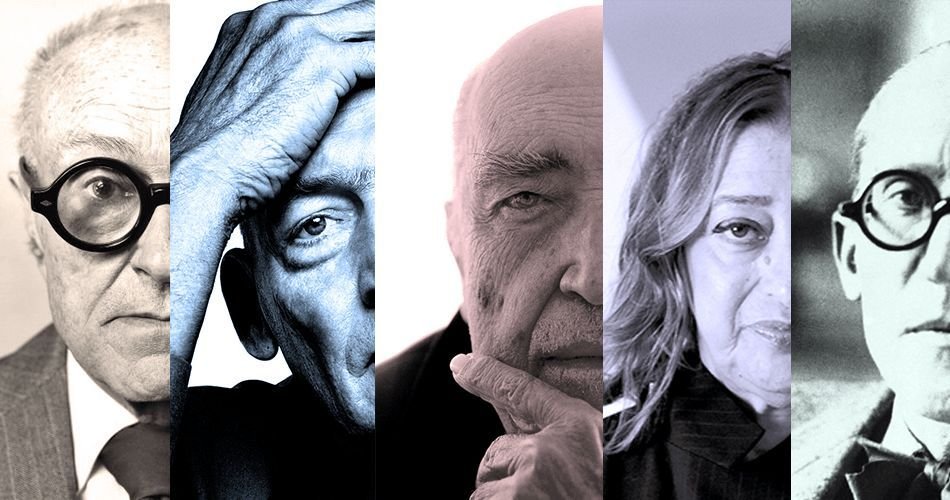
12 of the World's Most Influential Architects
A concise introduction to 12 architects who helped shape modern and contemporary architecture, from Frank Lloyd Wright and Le Corbusier to Zaha Hadid and Tadao Ando.
12 of the World's Most Influential Architects
Architecture has evolved through the ideas of designers who challenged established conventions and introduced new approaches to space, materials, structure, and the relationship between buildings and their surroundings.
The following list is not a definitive ranking, but it introduces 12 internationally influential architects whose work has had a significant impact on modern and contemporary architecture.
1. Frank Lloyd Wright
Frank Lloyd Wright (1867–1959) was an American architect famous for promoting an organic approach to architecture in which buildings respond closely to their environment. His long career produced hundreds of realized works and influenced generations of architects. Among his best-known projects are Fallingwater and the Guggenheim Museum in New York. The Frank Lloyd Wright Foundation notes that he designed 1,114 architectural works, 532 of which were realized.
2. Le Corbusier
Le Corbusier (1887–1965), born Charles-Édouard Jeanneret in Switzerland, became one of the central figures of modern architecture and urbanism. His ideas promoted functional planning, new construction technologies, and a radically modern architectural language. His important works include Villa Savoye, Unité d'Habitation, and Notre-Dame du Haut at Ronchamp.
3. Ludwig Mies van der Rohe
Ludwig Mies van der Rohe (1886–1969) was a major figure in modern architecture and became famous for an architectural language based on simplicity, structural clarity, open space, glass, and steel. The Barcelona Pavilion, Farnsworth House, and Seagram Building are among the projects most closely associated with his architectural legacy.
4. Antoni Gaudí
Antoni Gaudí (1852–1926) was a Catalan architect whose highly distinctive work combined architecture, structure, craftsmanship, color, and forms inspired by nature. His buildings have become defining landmarks of Barcelona, particularly Sagrada Família, Casa Batlló, and Park Güell.
5. Oscar Niemeyer
Oscar Niemeyer (1907–2012) was one of Brazil's most celebrated architects and a major figure in modern architecture. He became particularly known for expressive reinforced-concrete curves and played a central architectural role in the creation of Brasília. He received the Pritzker Architecture Prize in 1988.
6. Louis Kahn
Louis Kahn (1901–1974) was an influential 20th-century architect recognized for monumental geometry, carefully controlled natural light, and powerful use of materials such as concrete and brick. His major works include the Salk Institute, Kimbell Art Museum, and the National Assembly Building in Dhaka.
7. I. M. Pei
I. M. Pei (1917–2019) combined modernist geometry with careful responses to context and cultural institutions. One of his most internationally recognized works is the glass pyramid at the Louvre Museum in Paris. Other major projects include the Bank of China Tower in Hong Kong. Pei received the Pritzker Architecture Prize in 1983.
8. Tadao Ando
Tadao Ando (born 1941) is a Japanese architect known for minimalist spaces, exposed concrete, geometric simplicity, and exceptional control of natural light. Projects such as the Church of the Light demonstrate how relatively simple materials and forms can create powerful spatial experiences. Ando received the Pritzker Architecture Prize in 1995.
9. Frank Gehry
Frank Gehry (1929–2025) was a Canadian-born architect whose work became famous for sculptural, unconventional forms and complex geometries. His major projects include the Guggenheim Museum Bilbao, Walt Disney Concert Hall, and Fondation Louis Vuitton in Paris. He received the Pritzker Architecture Prize in 1989.
10. Norman Foster
Norman Foster (born 1935) is a British architect strongly associated with high-tech architecture, advanced engineering, lightweight structures, and technologically sophisticated buildings. His portfolio ranges from airports and headquarters to towers and major infrastructure projects. Foster received the Pritzker Architecture Prize in 1999.
11. Zaha Hadid
Zaha Hadid (1950–2016) was an Iraqi-born British architect celebrated for dynamic geometries and fluid architectural spaces. Projects such as MAXXI in Rome, the London Aquatics Centre, and the Heydar Aliyev Centre demonstrate the experimental approach that made her work internationally recognizable. In 2004, she became the first woman to receive the Pritzker Architecture Prize.
12. Rem Koolhaas
Rem Koolhaas (born 1944) is a Dutch architect, theorist, and co-founder of OMA. His work has explored architecture in relation to cities, culture, density, and contemporary society. Important projects associated with OMA include the CCTV Headquarters in Beijing and Casa da Música in Porto. Koolhaas received the Pritzker Architecture Prize in 2000.
Conclusion
From Gaudí's nature-inspired architecture and Wright's organic principles to the modernism of Le Corbusier and Mies van der Rohe and the experimental geometries of Hadid and Gehry, these architects represent very different approaches to design.
Studying their work provides more than a history of famous buildings. It shows how architecture evolves when designers rethink materials, technology, structure, space, and the relationship between people and the built environment.
Related articles
Why AI Is Important for Small and Fast Projects
AI can help designers and small businesses complete tasks faster, explore multiple ideas, and improve results without relying on long and complicated workflows.
Read article →
Astra 6 and 3D Design: Can AI Build Models Directly in Blender?
GPT-6 Astra introduces an important shift in AI-assisted 3D workflows: instead of only generating images, it can interact with software such as Blender and help create actual 3D scenes. Here is why this matters for architects and 3D designers.
Read article →
How to Write Professional AI Prompts for Architecture
A good architectural AI prompt is more than a description. Learn a simple prompt framework that helps architects communicate the project, task, design constraints and desired output more clearly.
Read article →